
As a child, when asked, "Are you alright?"
As long as I can remember, I'd answer " I'm half left". This was not simply a case of being pedantic - I didn't know this word then. It was only later when I worked as a Chartered Psychologist that I came to realise the importance of this reply. For one covert problem-within -the - overt presenting problem was acknowledging the role of the hegemony of the right.
Defining hegemony
The Encyclopaedia Britannica defines hegemony as:
... the dominance of one group over another, often supported by legitimating norms and ideas. The term hegemony is today often used as shorthand to describe the relatively dominant position of a particular set of ideas and their associated tendency to become commonsensical and intuitive, thereby inhibiting the dissemination or even the articulation of alternative ideas. The associated term hegemon is used to identify the actor, group, class, or state that exercises hegemonic power or that is responsible for the dissemination of hegemonic ideas

Forms of the right
The utterance "right", on the written page exists in four forms, deriving from two roots - rite and right:
● right: right not left hand.
● wright: arkwright, cartwright...., playwright, shipwright: all signifying craftsmanship.
● rite: last rites, signing of the cross with the right hand, “Heil Hitler!” with raised right arm.
● write: re-presenting, with pen, spoken words on the page.
Instances of the hegemony of the right
- "To make the right decisions you need the right information to hand." The Conversation Newsletter (0n-line 5/12/2023)
- "Are you alright?"
- "Are they in their right minds?"
- "The right way at the right time and in the right order!"
Implications and consequences of non-identified mind-body-mismatch
The core implications and consequences of not writing with the adept are summarised and tabulated as follows
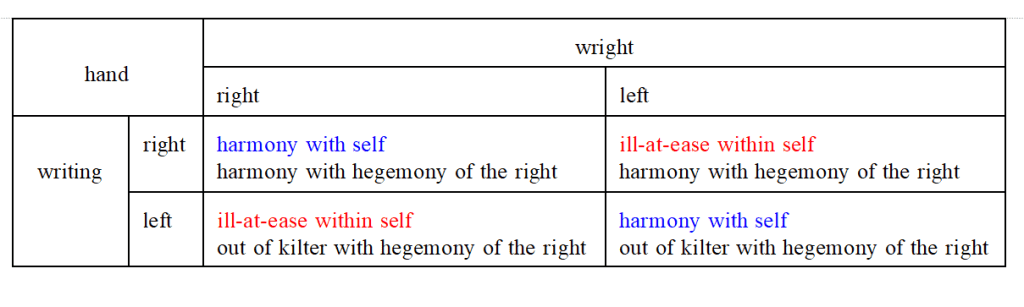
Can you spot the mismatch?
Blissful ignorance?
Stepping stones
About me
What problems?
Who needs to know?