
When handling any problem it's useful to consider how people frame their difficulties, dilemmas or doubts. Do they do so in terms of a problem, a predicament, a puzzle or a paradox?
- Problems are generally defined as obstacles of one form or other. Perhaps a problem would better be defined in terms of its solutions. If a proposed solution fails, it suggests that the problem was not properly defined.
- Predicaments are easier to identify. They generally take the form of "Should I do this or that?"
- Puzzles, too are easier to identify. They exist where all the pieces are (or appear to be) present but are not arranged into a coherent (literal and metaphorical) picture
- Paradoxes, A paradox is a situation or statement that seems logically self-contradictory or contrary to expectations, yet may be true or make sense when examined more closely. [Wikipedia quillbot.com]
It is a truism to say that no-one can please all the people all the time. It is equally true that no one lives a problem -, predicament-, puzzle-, paradox -free existence. It's only when these prevent us from achieve our goals that help is needed.
One of the paradoxically most intriguing cases I dealt with was with a young man who, when he introduced himself, said "I have a problem but I don't know what the problem is!". At first this sounds nonsensical. How can someone have a problem but not know what it is? And yet on further consideration it is probably one of the most sensible utterances. The argument being that if someone knows what their problem is then presumably they've attempted to solve it one way or other. The fact that, in their mind, it still exists, indicates that perhaps their problem was not what they first thought it was.
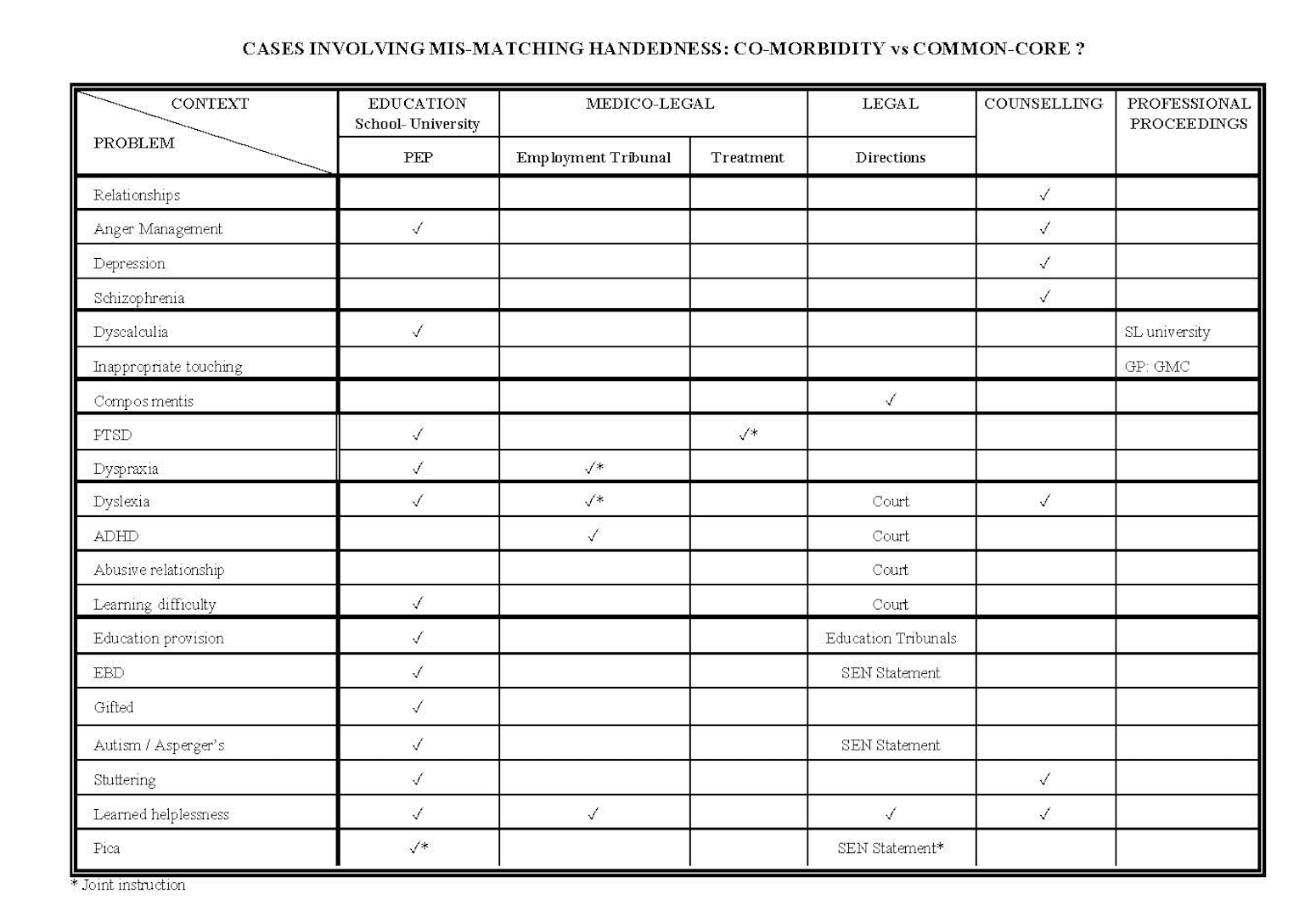
Here I tabulate those cases where I found writing with the non-adept hand to have been implicated in the presenting problem.
Spot the mismatch?
Who needs to know?
Stepping stones
Are you alright?
What problems?
About me